Thursday, July 30, 2015

...teaches reciprocally.

"It's not what you are that holds you back, it's what you think you are not." 

Monday, July 27th: First, happy birthday Grandma Jane! We sure do love you. Today was a fairly relaxed day. It was a village day, and contrary to our recent trend, the weather was actually nice for a village day. It seems that 90% of rainy days here are village days. Not today however! We started, per usual, with language before heading to our village training site for a culture session on death and mourning. It was a little somber as could be expected, but the mourning process here is important and could effect our lives as volunteers should somebody on our homestead or apart of our family pass away. After the cultural session we went for our final permagardening practicuum. Having already laid out the berms and retention holes, all that was left was to dig (kughuba) the beds for planting. Due to the amount of volunteers willing to help the beds naturally didn't turn out as expected, ours were a little skinnier than the one meter mark. After the beds were formed and the soil amended with manure, ash, and charcoal, we were ready to plant our seeds and seedlings. First, we learned about crop rotation and companion planting, which can get quite complicated, and then we planted. Finally, with a finished garden, we broke for the day. We also received our LPI scores at the end of the day with neither Grace nor I doing well. We were frustrated and have a plan for the next LPI to ensure we are tested fairly, but for now we are pushing it out of our minds. We returned home and went on a chore accomplishing spree, burning trash, doing laundry, and cleaning our floor. We then ventured up the road to buy some tomatoes and cabbage (20 tomatoes and a cabbage for $1.50, not bad). We made some wonderful veggie burgers for dinner and we are settling in for a movie, so I’ll end here for the evening!

Tuesday, July 28th: We ate bean burgers again tonight, because well, Sean made them so excellently last night that I wanted them again tonight. A girl could get use to all this wonderful cooking you know? Anyways, that was the end of our night. So as for today, we were taught how to teach. A long story, about a day worth of not so interesting stories, short, we are now expected to teach a class at the high school on Thursday. With an entire day of planning tomorrow it will be interesting what our group decides to teach about, I guess you will know soon enough! When we arrived home Sean collected all of our dry laundry and I found myself in a political conversation with Simiso about Democrats and Republicans. She watched Obama’s speech in Ethiopia this afternoon. Walking back inside I told Sean that I need to be better versed in order to speak with Simiso again. We spent some time studying and I will remind you again how much I enjoyed my dinner. That is honestly all that I have, pretty weak huh? End note: Ryan, happy 28th birthday to you! Hope it was wonderful!

Wednesday, July 29th: Life never stops here in rural Africa, although it usually slows down for you. There's always, always, always something to be doing that needs done. It’s usually something involving water, fetching water, refilling filters, dumping waste water, etc., and those three somethings are in fact daily necessities for Grace and I. Then there's the dishes that must be hand-washed after every meal, laundry day (more specifically underwear day done inside and clothing day done outside), cleaning day, grocery day, and the list goes on and on. Sometimes there are obscure somethings that need done, such as dumping the pee bucket or disposing of alcohol containers, these somethings require a little extra care and subtle execution. With all of this to be done though, life here will occasionally throw you a curveball. Like today. Today we caught a curveball. Today, for one of the first times since we arrived in Sihhohhweni, we had nothing to do for about 2 hours. It was slightly disorienting. You see due to a rather lax day of language and presentation preparation (tomorrow we will teach 30ish 12-20yr olds about self-esteem at the local high school), we were able to get laundry and other water tasks accomplished during lunch, before finishing training elsewhere in the village. Typically, we must rush home after training to accomplish what needs done before dark at around 5:30. Today, however, due to the previously mentioned circumstances, we had about 2 hours of free time from 3:30 to 5:30. Unsure of what to do with ourselves we simply returned home. After talking with babe and make for awhile about babe’s health, babe has been quite sick lately with what we assume are ulcers, we still had an hour and a half to kill before dinner. Bosisi betfu (our sisters) were napping, so we settled in to our couches and contemplated what to do with this curveball we just caught. We settled on baking chocolate cookies in the frying pan, yes, Grace fielded this curveball perfectly. It was interesting to me though, that “free-time” was a little disorienting. There is no TV to relax by, no cold beverage for out on the porch, no walk to go get milkshakes, and no bike path to cruise along. I suppose it just makes me thankful all over again for the opportunities I had in the U.S. and the friend and partner I have here now. In conclusion, when you're surprised by unplanned downtime just remember to field that curveball gracefully, let life come to you, and don't turn down baking chocolate cookies, because that something is probably the exact something you were supposed to do. How’s that for a disorienting conclusion? Time to eat our cookies. 


Thursday, July 30th: I was able to talk with my mom today on her 49th birthday! If you haven't met my mother all you need to know is that she is the most amazing woman I know. If you do know her, and see or talk to her, tell her again how much I love her for me! Today we taught approximately 40 high schoolers about self esteem, self value, and confidence. With a short lecture and a game our group felt energized by the experience. A fellow volunteer group followed our presentation with a presentation on verbal and nonverbal communication. They did an amazing job as well. On the bus ride to SIMPA we discussed our surprise at how much fun we had teaching the class. Our desire here is not exactly to be working directly in a school, but the experience was most certainly more enjoyable than we had previously anticipated. At SIMPA training site we had a short debrief about the morning followed by an extra long lunch break. We took our normal 1 mile stroll down to the imakethe to purchase some vegetables. We bought around 6 onions, 8 potatoes, 6 green peppers, and 10 tangerines for 40 emalangeni or 4 U.S. dollars. Back at SIMPA we had time to study, talk with friends, and sign up for a half marathon at the end of September. We are in it for the shirt, just like many other volunteers are. The next section focused on orphaned and vulnerable children (OVCs). We now understand that OVCs are defined by poverty level and not specifically lack of parents or guardians. An child can be an OVC if his/her parents or adult has AIDS or lives with a grandparent. The definition is very vague and the government response is now truly just being established to combat the growing problem. 15% of households are child headed households. Free healthcare is available for OVCs but someone has to advocate for the child to be recognized as an OVC. The unemployment rate is above 40% and while primary school is “free”, high school is not. So all of this information that makes your heart feel heavy  leads me to my next point. Where we fit in. The lecturer pointed out the need for trade/technical skills. Deemed “lower class” people tend to shy away from these jobs but for OVCs in our community I know a pretty smart guy who has a masters in trade skills. Neighborhood Care Centers are available for OVCs in communities to receive free meals, however, they lack the funds to maintain supplies to feed the children. A community permagarden would provide supplies for no cost. While there is profound need in this specific population, there is also profound work to be done. And isn’t that why we came? Our plan for tonight is to teach our bosisi banana-grams. Sean will play in SiSwati while they play in English. I'm cheering for our bosisi, Sean always wins…

Sunday, July 26, 2015

...is one month old!

"The secret of change is to focus all of your energy, not on fighting the old, but on building the new"." -Socrates


In celebration of our one month (and one day because we’re late) arrival anniversary, we thought we’d explain some normalcies of our everyday life that were not so normal pre-arrival. 

Number one, buckets. Usage, let us count the ways. We fill buckets, we stack buckets, we pee in buckets, we wash in buckets, we spit in buckets, we scrap in buckets, we store in buckets, and we dump buckets. We never truly gave buckets the credit they are due until now. We will take any bucket devoid of holes and preferably with a handle. The handle might be asking too much. We possess little buckets, bigs buckets, wobbly buckets, buckets with lids, and colorful buckets. We’re just saying, we live by the bucket.  

Number two, water. We live each day off of about 8 liters of water. This 8 liters includes drinking, cooking, bathing, and dishwashing water. Oh yea, add about another liter for laundry day once a week. Just for added clarification, yes we wash our vegetables, yes we brush our teeth, and yes we drink about three cups of hot tea a day, all of which is included in the 8 liters we consume. It took a little while to get used to but we don't lack. Try it – you’ll hate it! 

Number three, the umthoyi (toilet). There is no need to flush when there is no flush. It is truly interest to find yourself having to return to a flushable toilet, to flush, due to the indoctrination of the sit, shit, stand, shut, strut. We will have bigger marital problems that the average “who left the  toilet seat up” when we return. Furthermore, it has become common to converse about toilet paper. “Did you bring some?”, “Do you have any?”, “Can I borrow some?”, “Are you out?”, “What else do you got?”. If you want friends in Swaziland, make sure you are packin’.

Number four, mirrors. Mirror mirror on the wall… Just kidding, there is no mirror to tell us who the fairest of them all is. We look rough, we don't need a mirror to tell us that. And good thing because we don't have one. We look in a mirror, on a good week, twice a week. Mirrors usually accompany indoor plumbing.  It was an interesting feeling at first rarely see ourselves, but we have grown accustomed to being less vain. The only mirror we use is honesty… “Grace, you have something stuck again in your teeth”, “Sean, push your nose hairs back inside your nose”. 

Number five, livestock. Old McDonald had a farm and we live it on it. Between Ronald and his girlfriends, the three billy goats that walk the bus route, and the King’s herd of royal cows that line both the streets and parking lots of Swaziland, we tread lightly and walk in zig zags to avoid the unavoidable. Poop. With livestock as a livelihood, we have the utmost respect for our free-range friends. If a cow is walking down the middle of a road, we step to the side. If a cow is walking down the middle of a highway, we pull to the side. Now, we even think in cow currency. Our salary combined is equal to one cow a month. If we saved all of our cows, in 17 months we could buy Alden a wife. Not a royal wife, we need better jobs for that.

Can you imagine what 2 months will bring? We know we will at least have “two cows” by then! 

Friday, July 24, 2015

...makes time for cookies and wine.

"Success is going from failure to failure with enthusiasm." -Mark Twain

Tuesday, July 21st: In celebration, or in my case languish, of our mock language proficiency exam tomorrow I shall tell you about our day in siSwati. Please, in no way should you be impressed. Tonight, while studying in the kitchen, our sixteen year old sisi remarked, “they sound like Letho”, who happens to be our 3 year old sisi. So it is clear that progress remains. Anyways, here it goes.
Ekuseni siye thishela Shongwe indlu. Sidadishe siSwati ne bangani wetfu. Sihambe eSIMPA ebhasini. Namuhla, sifundze HIV/AIDS futsi. Bese siye kaMahala kutsenga kudla. Sitsenge lubisi, ematamatisi, pele pele, shukela, ne emabhontjisi. Siye eSIMPA na sifunze na emavolontiya ka Peace Corps. Sime kugibela eSihhohhweni. eSihhohhweni sipheke irice, ne tibhuduo stirfry. Sisi Simiso ufundzise siSwati. Nyolo, siyanatsa litiya be siyadla no bake cookies. Lala kahle umdeni eMelika!
(This morning we went to teacher Shongwe's house. We studied siSwati with our friends. We went to SIMPA on the bus. Today we learned about HIV/AIDS again. And then, we went to Mahala to buy food. We bought milk, tomatoes, pepper, sugar, and beans. We went to SIMPA and studied with Peace Corps Volunteers. We waited to ride to Sihhohhweni. In Sihhohhweni we cooked rice and stir fry vegetables. Sister Simiso taught siSwati. Now, we are drinking tea and eating no bake cookies. Good night American family!)

Wednesday, July 22nd:  Tonight has been an awesome night! We made 75% homemade spaghetti sauce (I cheated and put in tomato paste…hence the 75%), noodles, homemade garlic bread, and not so homemade South African merlot wine. To top it all off we ate an absurd amount of lemon cream cookies (our favorite) while watching the Italian Job on our computer, thanks to our impressive collection of 250 or so odd movies. It has truly been a splendid evening, with Grace and I’s favorite sound emanating from a rainstorm on our unique roof. Yes tonight has been the best of nights, but perhaps not the best of tomorrow mornings…we shall see. 
Oh yes. Today! I forgot to talk about today! Today was the epitome of frustration and misdirection. Pardon my French, but today sucked (I only say pardon my French because I still remember as a young boy in Iowa being scolded by my great aunt and great grandmother for using such a vile word…today however it is fitting). Grace and I awoke this morning full of confidence and hisses and clicks for today was our infamous Peace Corps round robin. A day in which all of our skills and training would be put to the test in a series of 8 one-on-one interviews, including the ever-daring language proficiency interview or LPI. I don't want to dig too deep into a wound which Robertson Winery has already quelled, so I will provide you with only the most minute details about the LPI. 
For those of you unaware, the LPI is a test, mandated by our magnificent government, which seeks to evaluate Peace Corps trainees on their progress in learning the native language. In our case such a language is called siSiwati, and it is as foreign to the English-speakers tongue as Mandarin may be to a monkey’s. (Sorry monkeys) In any case however, one must score above or at the rank of intermediate low in order to serve in the Peace Corps void of any contract or extra agreement. For the purpose of this test, only 4 weeks in, the expectation is that we score somewhere around novice mid to novice high. Now, let me tell you my grievances with such a test. First of all it is a test to failure. You continually answer questions in a series of 5 topics (family, occupation, recreation, travel, and education) until you fail and must start again in a new topic. I understand the reasoning for the test structure but just because you may understand as well, please do not think that when in such a test, or when answering such questions, the level of stress or sense of failure is in any way mitigated by the fact that the test is designed around a participant’s failure. Secondly, the test is entirely in the hands of the individual tester, or interviewer. One may get a ridiculously easy interviewer, where the questions are equivalent to those practiced, or one may get a ridiculously difficult interviewer, where the questions are posed in any form except for those which you know. Unfortunately, such was the case for Grace and I. We had a ridiculously difficult interviewer. Once again, the wine has quelled the worst of our lamentations so I will not get into details, but I will say that Grace and I struggled equally, as did another trainee who is widely regarded as the best speaker in our group. Other trainees faired much better, or so they said, but LPI interviewer #8 proved to be the downfall of many a trainee today. Such is this life of ours I suppose. We are now prepared for the absolute worst in future testing, because we received such today. The interview given by the loathed #8 gave not even the slightest hint of following proper protocol for which Grace and I were well prepared and for which our grand government paid dearly for. No. Today was not the best of days, but it was not the worst of today's either. We will wait and see what tomorrow's LPI scores bring, and depending on the values, perhaps we will buy another box of wine. 

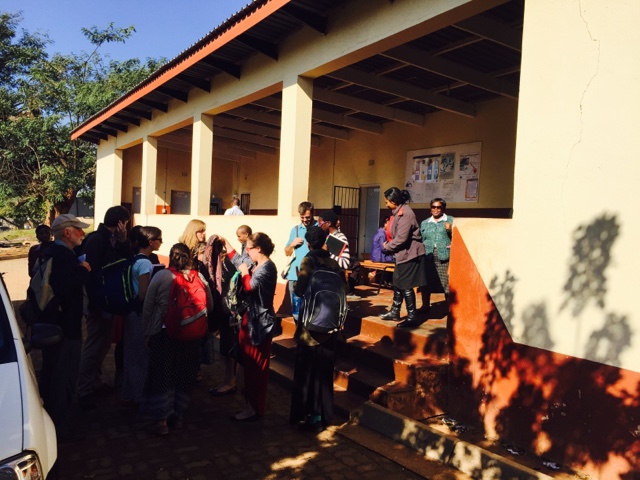
Thursday, July 23rd: Sean got a pep talk from Make Shabangu this morning. I got a pep talk at the dinner table from Make tonight since I didn't receive one this morning. It feels good to be loved so much. So our day started and ended wonderfully. The rest of the day turned out to be one of my favorites thus far. We arrived at SIMPA and broke into 4 groups in order to travel to separate health facilities today. Sean traveled to King Sobhuza II Public Health Clinic (pictured below). His experience was one of extreme interest to me and it seemed as though the government facilities are taking a wholistic approach to health with many preventative measures being free of charge. With a focus on pre/post natal care and mother to child transfer (MTCT) the clinic sees on average 200 people per day. Free contraceptives, HIV testing, and immunization are given and mobile outreach is available. I ended up at the Population Services International (PSI), so the majority of the morning I learned all about male circumcision, condom distribution, and HIV.  PSI focuses on men's health including sexual health, HIV Testing and Counseling (HTC), and male sexual and reproductive health. With a primary focus in outreach education and testing, PSI has a success rate of 64% linking HIV positive patients to treatment, well above the national average of 37%. Onsite they preform on average 60 circumcisions per day, males ages 10-70. While early infant male circumcision is allowed and encouraged in Swaziland it is still relatively new and needs more time to become the norm. The collaborative efforts between the Ministry of Health and active NGOs is very apparent and adds greatly to their success. Again, all of these services are free of charge.  Other volunteers visited MFS- Doctors Without Borders and Family Life Association of Swaziland (FLAS). The best part about all 4 organizations is that they are excited, willing, and ready to work with PCVs. It really can't get much better than that. With a better understanding of health facilities and health care needs in Swaziland I feel like it is beginning to really sink in. These issues will be a focus for me during the next 2 years, and I cannot wait to get started!


Friday, July 24th: What a way to round out the work week! Today we had the privilege of seeing and speaking with a sangoma or traditional healer. Sangoma’s have been around since the pre-Swaziland days, and their power and healing efforts are still sought after and respected today. Swaziland is a very magical place, when the Dlamini clan first united all the other clans they were only able to do so because they had superior magic. The current King and Queen Mother are both keepers of this same magic, and it awards them great power. Nonetheless, the Swazi people all have varying thoughts on magic, and because of these beliefs and concurrent doubts, sangomas can be found throughout the country curing Swazi’s of all curses and ailments save HIV/AIDS, which the sangoma we talked to said he cannot do. He sends them to hospitals instead. If you've got bad juju though, he’s your guy. Anyways, it was fascinating to see the sangoma’s dance and hear him yell (pretty sure I can call it yelling…) as he called his ancestors into his body and removed himself. You see, sangomas’ powers come from their family’s ancestors which the sangoma calls into his body. He is powerless without the ancestors, and his everyday life is largely dictated by what the ancestors want. The sangoma we visited is quite popular as we regularly hear the beating of drums and chanting at all times day and night. After the sangoma greeted us all through the ancestors and the ancestors blessed us and gave us luck, he released his ancestors and called back his spirit with more dancing and yelling. He then answered a few of our groups questions before returning to his indlu and we went on our way. It was very cold and rainy today so we were all in a pretty big hurry to get out of there and out of the elements. Post sangoma visit, we returned home with a few volunteers following, for a little belated birthday party for a volunteer that we have grown to love. In honor of the occasion I went to the sitolo and bought four different local beers to share with everyone. It was quite an interesting visit to the sitolo to say the least as I tried to both explain what I wanted and why I wanted it. No matter though, I rode the wave of laughter right out of the store all the way back home where our guests were thrilled to receive such a treat. Grace made no bake cookies and popcorn and we spent the rest of the afternoon just enjoying our friendship and hanging out. There are quite a few fans of tiny houses and western North Carolina in our little group, so perhaps we will return to the area with a few PCVs in tow. It was a blast and this weekend is set to be even better as we pack for a two day Peace Corps excursion to the Ezulwini Valley near Mbabane. In store are visits to King Sobhuza’s memorial, the national museum, a cultural village, and a game park with an overnight stay at Legends Backpackers, where we hope hot showers await!

Monday, July 20, 2015

...wins some and loses some.

"Courage doesn't always roar. Sometimes courage is the quiet voice at the end of the day saying, 'I will try again tomorrow'". -Mary Anne Radmacher

Saturday, July 18th: Everyday in Africa requires a mission. Not like a top secret mission or anything but an important mission none the less, or that's how I like to think of it. Most days require water missions, some days require food missions, other days require latrine missions. Such is life here. You skip a mission for a nice relaxing nap and before you know it your laundry mission is hell. Today's mission however, was a fun mission. Today we went on a food mission (we ran out of wine and eggs, oh and not having a sponge gets really annoying) that involved our first public transportation mission. I was a little nervous. Grace was really excited about the sponges. And so our mission began. 
We got up at 8:00am enjoying our off day and sleeping in a bit, but by 8:30am I was out on a water mission asking our sisi, Simiso, all sorts of questions that would be pertinent to the success of our food/public transport mission later that day. I was informed that the cost of the bus ride was 6 emalangeni and it would drop us off at a siteshi near SIMPA that we were familiar with and which left us with a brief twenty minute walk to Spar, our target for our food mission.  The bus would come to the sitolo in Sihhohhweni at 11am so we had plenty of time to get ready and practice some siSwati as well. In the middle of our study session there was a knock on the door, Simiso had come to our door to inform us that her older brother, Nkhosingiphile (Ngiphile for short), would be leaving for his home in the south at 10am, and that he and his wife would be happy to drive us into Mahhala. We readily accepted the offer and planned to just take the bus back home upon completion of the food mission. So yes…we may have cheated a little, or a lot, depending on how you feel about 50%. We didn’t care though, we were happy to share the ride and talk about the weather. Ngiphile is sure that he would die in a Tennessee winter. Once we arrived in town we walked to Spar to gather up what we needed and browse a little since the bus home wouldn't depart until 1pm and it was about 10:45am. We left Spar very successfully and we even managed to snag a couple candy bars for our bosisi. We headed back to the main shopping complex where we stopped in for lunch at Galito’s. After lunch, with plenty of spare bus change on hand, we walked to the siteshi about 20min away. We arrived at the stop at 12:30pm and settled in to wait for our bus. Simiso had advised us to ask the Swazi's at the siteshi if any of them were going to Sihhohhweni, and then simply fall in with them. However, having already cheated a little and having displaced all the locals from the community bus a few days ago when our private one broke down, we were confident that we could pick out our bus when it came. Sure enough an hour later, and after Grace had time to study all the siSwati verbs we know, our bus came and we heard the conductor shout eSihhohhweni. We boarded the bus confidently and then fumbled our way to the rear to take a seat, backpacks and grocery bags intact. We were wondering when and if we were going to have to pay when about halfway home the conductor rose and starting collecting money. He made his way smoothly down the aisle asking what seemed like random people to pay random amounts of money. This guy ten emalangeni, that guy 8 emalangeni, this lady 9 emalangeni…we were just about to go digging for our wallets when he made it to us and Grace asked “Malini?” or “how much?”. He said 6 emalangeni a piece. We paid no problem and then started an interesting discussion amongst ourselves because we could not see any sort of system that would allow the conductor to know who paid and who didn't and who owed how much from one stop and who owed how much from the next. Not a single complaint arose from any of the passengers however so we resided to let our discussion subside and continue on in peace. Also because if you don't focus on the road for too long you tend to get sick. After half an hour we arrived at the sitolo in Sihhohhweni and we exited the bus, successfully completing our 3rd mission of the day. We found our family both relieved and proud that we had navigated the Swaziland bus system by ourselves and efficiently, as our entire trip only took about 3 and a half hours. We studied a bit and Grace went on a laundry mission, which I later joined, before we used the feta cheese we acquired during our food mission to make skillet pizzas for dinner. They were delicious. However, now we’re all missioned out, and I'm beginning to smell cinnamon apples for dessert so…over and out from Swaziland.
Oh wait, I suppose I have to go on a bathing mission…

Sunday, July 19th: I really dislike body day. For those who have forgotten, Sean and I rotate between hair day and body day in order to maintain some form of hygiene and cleanliness. Don't get me wrong, I am super happy to have the ability to try and stay clean. But my opinion of body day is just that, just a  try. In order to bath you technically need soap and water, which I have. Space and containment of water is what I am lacking. Usually I end up with left over soap or patches of dirt on my body. This change of pace is a definite change of character for me, being an overly clean freak. I try to compensate for my every other day fail of body day. We have “house shoes”, as in I make Sean wear different shoes in the house as to not track mud in or bring muddy feet into the bed. I bought wet wipes yesterday. What a great purchase, yet I'm afraid they will be all gone soon. I have a “dishwasher”, meaning I dedicated a pot to put other dirty pots in. I have a hand washing station, expectations for teeth cleanliness, and a smell test for shirts wore more than once. Often I have jokingly told my mother, from who I inherited this over-awareness, that cleanliness is an illusion. I am finding more and more that is in fact true. So body night will continue, because falsifying cleanliness will save my sanity. 

Monday, July 20th: There’s no way around it…today has been a rough day. It wasn't rough because we had a long day of lectures on the history of Swaziland, behavior change, and culture. It wasn't rough because it was abnormally hot at lunch time when we went running. It wasn’t even rough because Khombi, our 16yr old sisi, caught me buying a beer after dark at the sitolo (it's for cooking *wink). Today was rough because we had our first Peace Corps trainee ET. For those of you who don’t know, ET stands for early termination and it is rarely talked about in the Peace Corps society but it is something that occurs with every group of volunteers. It was rough because we are all family now, we all look out for each other, and we all pick each other up when one is down. This particular family member we all thought was one of our strongest. A vibrant, poetic, uplifting individual with a hearty smile and a big heart. It shocked us all that he left, but nobody would ever dare blame him for it. We just wanted to say goodbye and farewell, good luck in all things, and thank you for being a part of our family. It was a rough day because we lost a dear friend, a brother in our Peace Corps family. As Grace and I sit here solemnly reflecting and thinking of our friend, and of those closest to our mutual brother, it's hard not to be down. We knew that an ET was inevitable during our service, and I'll go so far as to say that there were others strugglingly more outwardly than he, but we didn't know what impact it would have. It serves as a reminder to us all of the commitment we are making, and the gravity of it all. We all have things that pull us home, but we all have hearts that keep us here. We listen to both sides of this metaphorical coin, neither side ever being wrong. 

With love to our families be it McCord, Collins, Shabangu, or Peace Corps,

Sean and Grace